
Home » Leistungen » Root Canal Treatment
Root Canal Treatment (Endodontics)
This is how we preserve your natural tooth structure – despite inflammation
The field of endodontics is all about healing diseases within the tooth. The primary goal is always to preserve the tooth, because nothing is as precious as your natural tooth.
With Sensitivity
and Expertise
The anatomy of tooth roots is very complex, which is why they can only be treated with specialized instruments. Individual characteristics of the root canal system can be better identified with an operating microscope.
Have you had a root canal treatment before? Then you know what matters: calm and composure, as well as the precision and empathy of the treating dentist.
Modern endodontics offers excellent possibilities to preserve teeth even when the dental nerve is diseased or has died.
When is a root canal treatment necessary?
Inflammation, usually caused by caries bacteria or tooth injuries from accidents, permanently damages the inside of the tooth. The result: severe toothache. In such cases, prompt root canal treatment is necessary.
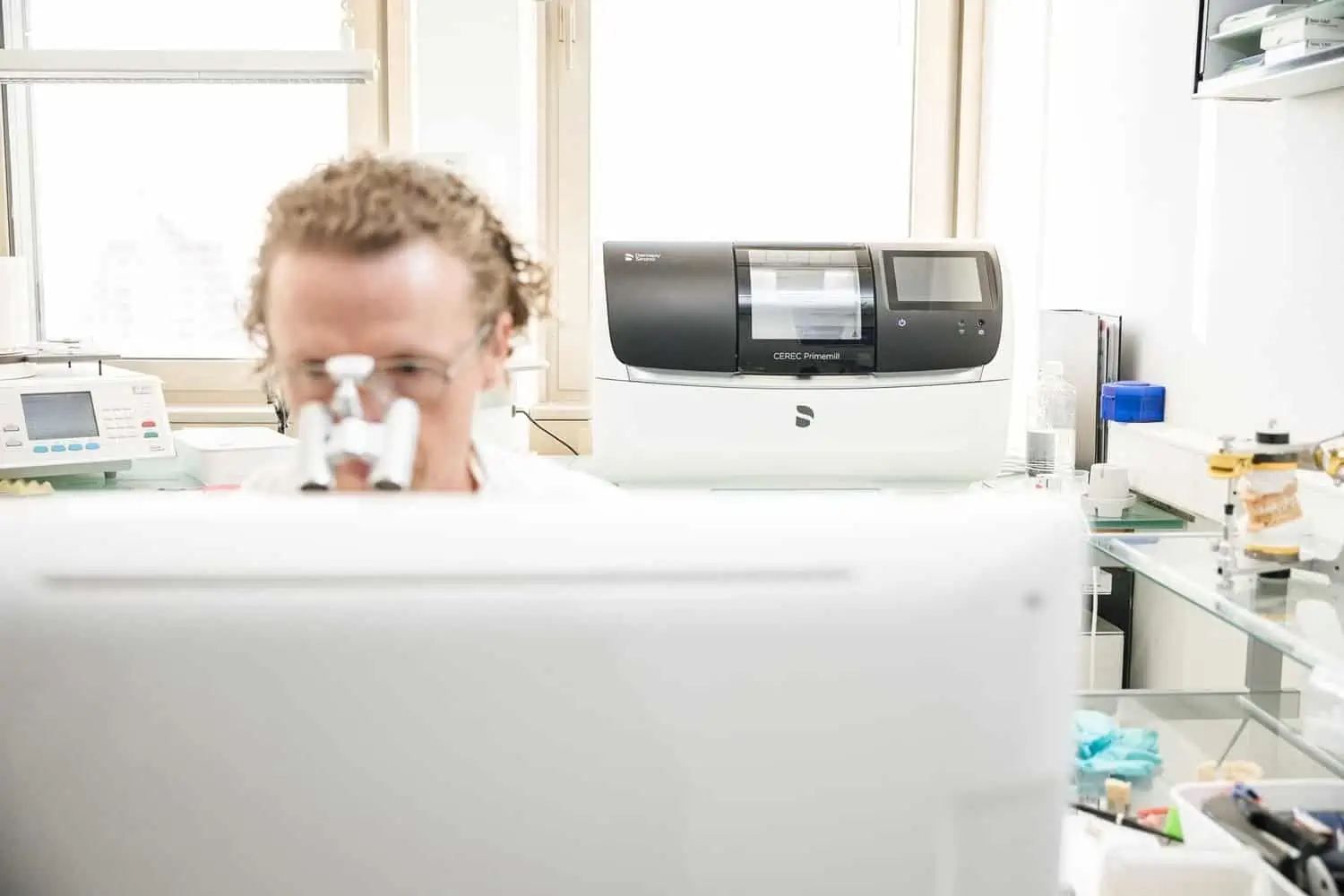
Modern Dental Microscopy
Modern endodontics offers excellent possibilities to preserve teeth even when the dental nerve is diseased or has died.
For our examination, we use state-of-the-art dental microscopes.
Inflammatory reactions in the jawbone, which are due to infections inside the tooth, can be avoided or healed with root canal treatment.
The Good News
With modern techniques, which have rapidly advanced in recent years, teeth can be preserved for many years with timely and thorough treatment. This is true in over 90 percent of cases. What happens if the tooth is too brittle, too loose, or permanently infected? Then, as a last resort, it must be extracted. But don’t worry: the resulting gap can be closed with a bridge, an implant, or removable dentures.
Pain Progression and Medical History
Afraid of pain during a root canal treatment? Find out how our anesthesia options can help you.
Root Canal Treatment
at a Glance
Even severely inflamed or already dead teeth do not necessarily have to be removed today. Through precise cleaning and bacteria-tight sealing of the root canal system, the natural tooth structure can be stabilized long-term.
Our Services
- Medical History
- Clinical examination and diagnosis, if necessary, using 3D X-ray imaging
- Root canal treatment through intensive and elaborate disinfection measures under local anesthesia
- Filling/Preparation for Dental Prosthesis
Our Additional Services
- Treatment under the microscope
- Electrical length measurement of the root canal
- Sonic-assisted disinfection of the entire canal system
- Three-dimensional root filling without voids
- Digital Volume Tomography in high-resolution mode (3D X-ray)
- Revision of previously root canal treated teeth
Do you have questions about root canal treatment?
Here you will find answers to the most frequently asked questions.
Yes. Both terms refer to the treatment of inflamed dental nerves within the root canal.
Naturally, our specialists perform root canal treatment only under anesthesia to ensure you experience as little pain as possible.
To successfully treat tooth roots, extensive experience, utmost precision, comprehensive expertise, and a great deal of sensitivity are required. The anatomy of tooth roots is extremely complex. Therefore, they can only be identified, cleaned, measured, and sealed with specialized instruments. Additionally, lateral canals are often difficult to detect, and there is a risk of perforating a canal during cleaning.