For many patients, the idea of a removable full denture (the classic “teeth in a glass of water”) is a nightmare. The fear of teeth wobbling when speaking, reduced taste perception due to palatal plates, and painful pressure points is significant.
For a long time, the path to fixed teeth was difficult: lengthy bone augmentation and months of healing without teeth were often required. The All-on-4® treatment concept has revolutionised implantology here. It makes it possible to provide a completely toothless jaw with a fixed restoration in just one day.
But how does this work biologically? And is it suitable for everyone? Here is the medical fact check.
The physical principle: angled instead of straight
Normally, we place implants vertically into the bone. However, if a jaw has been toothless for a long time, the bone recedes (atrophy)—especially in the posterior region, where the maxillary sinus runs in the upper jaw and the nerve runs in the lower jaw. In the past, bone had to be built up artificially here.
The All-on-4® concept uses an ingenious biomechanical trick:
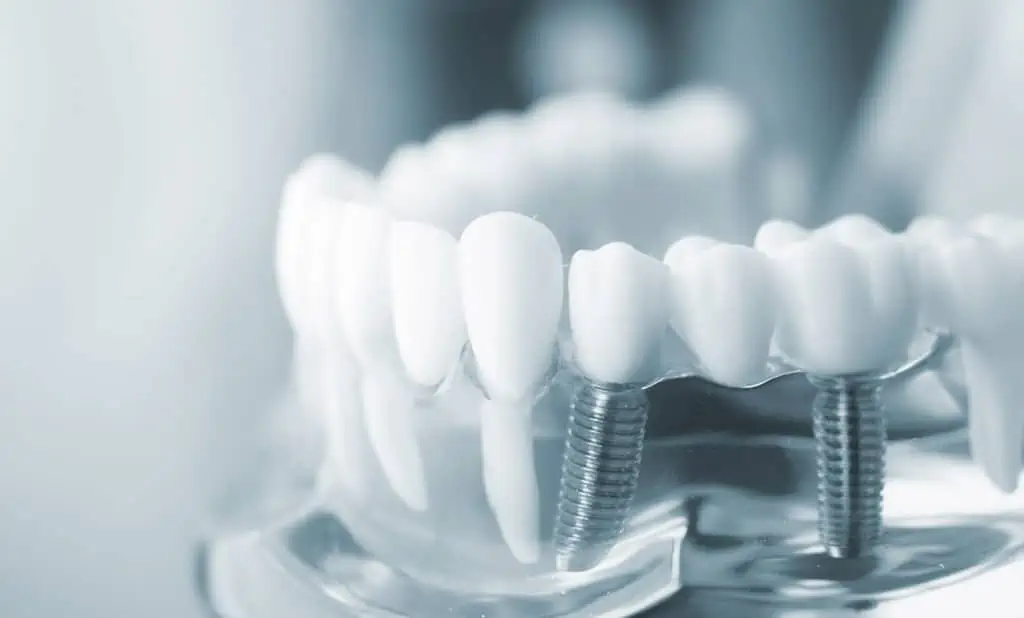
- The front two implants are placed straight, where there is usually still enough bone available.
- The back two implants are placed deliberately at an angle (30–45 degrees).
The advantage: By angling them, we avoid critical structures (nerve/sinus) and make optimal use of the available bone. In addition, we extend the support area towards the back. This provides stable anchorage (“primary stability”) without the need for bone augmentation.
The process: a gap in the morning, a fixed bridge in the evening
The term “fixed teeth in one day” refers to what is known as immediate loading.
- Diagnostics & 3D planning: Before the procedure, we take a three-dimensional X-ray (CBCT). We plan the position of the four implants to the millimetre on the computer to protect nerves and blood vessels.
- The procedure: In a single session, any remaining teeth that cannot be preserved are removed (if present) and the four implants are placed.
- Immediate restoration: On the same day, a fixed temporary bridge is screwed onto the implants.
- The psychological effect: You do not leave the practice with a removable denture or a gap, but with fixed, screw-retained teeth. You can immediately interact socially again, smile and speak.
IMPORTANT: The rules for healing
Here we need to correct a piece of misinformation that often circulates online: although the teeth are fixed immediately, the bone needs time to grow onto the titanium surface (osseointegration).
- Diet: For the first 6 to 12 weeks, a strict “soft food” diet applies (pasta, fish, scrambled eggs). Excessive force (nuts, crusty bread, tough meat) could disrupt healing and lead to implant loss.
- Care: Because the bridge is firmly screw-retained, we will show you special cleaning techniques (Superfloss dental floss, oral irrigators) to keep the areas under the bridge free of inflammation.
The final step: the definitive restoration
After about 3 to 6 months, biological healing is complete. We then replace the temporary restoration with the definitive bridge. This is usually made of a high-strength titanium framework or zirconia and is designed aesthetically so that it is hardly distinguishable from natural teeth.
Who pays for what? A look at the costs
In the German healthcare system, the cost allocation is clearly regulated, but often confusing for patients:
- The implants (surgery): Placing the artificial tooth roots is a private service. Statutory health insurance (GKV) generally does not cover these costs.
- The restoration (prosthetics): The GKV pays a fixed subsidy. This is based on the so-called standard care (usually a removable denture). However, you also receive this fixed amount as a credit towards the All-on-4® solution.
Conclusion: All-on-4® is a proven, scientifically well-documented method for regaining quality of life immediately. It is more cost-effective than traditional methods (as fewer implants are needed and no bone augmentation is required), but it does require discipline with diet during the healing phase.
Would you like to know whether your bone volume is sufficient for this method? We would be happy to clarify this in a non-binding diagnostic appointment.