
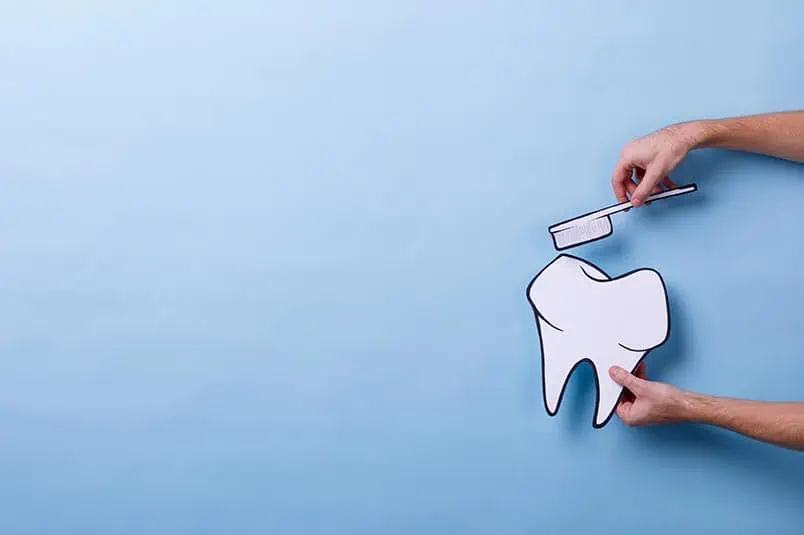
For a long time, caries was considered an unavoidable evil that affects almost everyone at some point. Today we know better: caries is an infectious disease that is almost 100% preventable. A “cavity” in the tooth does not develop overnight. It is the final stage of a long process in which the chemical balance in your mouth is disturbed.
Understand this process and you have control. As your dental team, we want to show you how you can not only stop this process, but actively reverse it.
The Principle: A Constant Tug-of-War
Your teeth are in constant chemical exchange. Bacteria in the biofilm (plaque) metabolize carbohydrates into acids. These acids dissolve minerals such as calcium and phosphate from the enamel (demineralization).
Normally, your saliva repairs this damage by redepositing minerals into the tooth (remineralization). Caries only develops when the phases of acid attack last longer than the phases of repair. Here are your four most important strategies to win this tug-of-war:
Strategy 1: Frequency Over Quantity – Give Your Teeth Breaks
It is a widespread misconception that only the amount of sugar is decisive. For your teeth, it is rather the frequency of sugar consumption.
- The problem: Every time you eat sugar or fermentable carbohydrates (also in chips or white bread), the pH level in the mouth drops. The tooth loses minerals.
- The solution: Reduce the number of “sugar hits.” Eat sweets preferably as dessert directly after a main meal, instead of snacking repeatedly throughout the day. Give your saliva 3–4 hours between meals to repair the teeth.
- Thus
Strategy 2: Fluoride as a Protective Shield
Fluorides are indispensable in modern dentistry. They integrate into the tooth structure and make the enamel more resistant to acid attacks. Moreover, they accelerate the return of minerals to the tooth.
- At home: Use a fluoride toothpaste daily (adult dose: approximately 1450 ppm fluoride).
- Pro tip: After brushing, only spit out the foam, but do not rinse with water. This way, the fluoride remains on the tooth longer and can work more effectively (“Spit, don’t rinse”).
- Nutrition: Since our drinking water in Germany (unlike in many international studies) is not fluoridated, we recommend using fluoridated table salt in the household.
Strategy 3: Mechanical Disruption of the Biofilm
Bacteria organize themselves in an adhesive biofilm. If it is not regularly disrupted, it matures and becomes more aggressive.
- The 2-minute rule: Brush all tooth surfaces systematically for at least two minutes twice daily. Electric toothbrushes or sonic toothbrushes take much of the work off your hands and often clean more effectively than manual toothbrushes.
- The problem areas: The toothbrush reaches only approximately 70% of tooth surfaces. The interdental spaces are the most common site for caries in adults. Daily use of dental floss or, even better, appropriate interdental brushes is therefore not optional, but essential for healthy teeth.
Strategy 4: Saliva Stimulation
Your saliva is the most natural “mouthwash.” It neutralizes acids and provides the building blocks for tooth enamel.
- Drinking: Adequate water intake ensures saliva production.
- Chewing: Chewing sugar-free gum (ideally with xylitol) after eating mechanically stimulates saliva flow and helps break down acid peaks more quickly.
When to See a Professional?
Even with perfect home care, there are niches you cannot reach. Additionally, caries in its initial stage (initial caries) often progresses painlessly and invisibly to the naked eye beneath the surface.
- Diagnostics: We often detect demineralization long before a cavity forms—and can heal it through fluoridation without drilling.
- Prophylaxis: During professional teeth cleaning (PTC), we remove the biofilm even where toothbrushes and dental floss fail.
Caries prevention is teamwork. You handle the daily care, we provide professional monitoring. A good balance here is ultimately more than half the battle. Schedule your next check-up in time.