
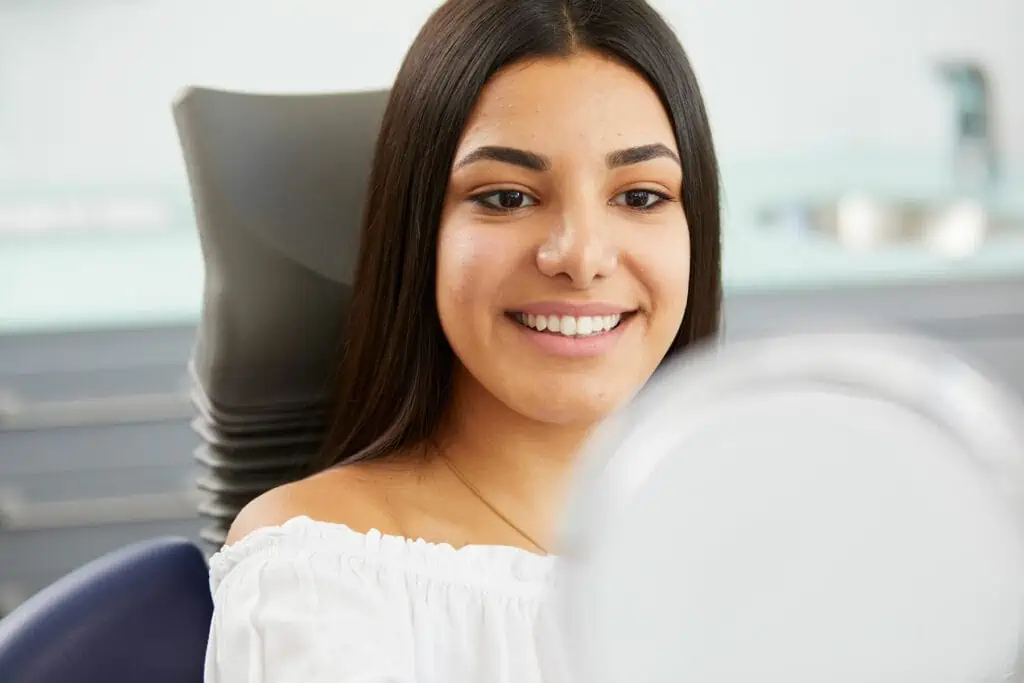
A radiant smile is often equated with vitality and health. However, over the course of a lifetime, tooth enamel loses its brightness – be it due to the natural aging process or through consumables like coffee, tea, and red wine, whose pigments penetrate deep into the tooth structure.
Many patients express a desire for whiter teeth. The good news: whitening (bleaching) is now an established, safe procedure – provided it takes place under dental supervision. Because bleaching is not a cosmetic procedure, but a medical intervention into the tooth structure.
How does bleaching actually work?
The principle is chemically similar to hair bleaching, but it is adapted to the mineral structure of the tooth. We use gels containing hydrogen peroxide or carbamide peroxide. These substances release active oxygen. This oxygen penetrates the tooth enamel and breaks down dark color pigments through oxidation. The tooth substance itself remains intact; it is merely “decolorized.”
Important: The check-up before bleaching
Before we start, a thorough examination (“bleaching suitability”) is essential. Why?
- Healthy foundation: The gums must be free of inflammation and the teeth free of cavities. A bleaching gel that penetrates an open cavity can irreversibly damage the tooth nerve.
- The filling trap: Bleaching agents only work on natural tooth substance. Crowns, veneers, and composite fillings do not get lighter. If you have fillings in the visible front tooth area, these may need to be replaced after bleaching to avoid color differences.
Our method: In-Office Bleaching (Philips ZOOM)
For fast and intensive results, we rely on “in-office bleaching” directly in the practice. This involves the use of higher-concentrated gels, which, according to the EU Cosmetics Regulation, may only be applied by medical personnel.
The procedure for a session:
- Protection: Your gums and lips are completely covered, so only the teeth are exposed. Safety is our top priority.
- Activation: The whitening gel is applied. We use special lamp systems (e.g., Philips ZOOM), whose light wavelength activates the decomposition of peroxide and accelerates the process.
- Cycles: We usually perform 3 to 4 cycles of 15 minutes each in one session. You will see the result immediately after the appointment – often up to 8 shades lighter.
The alternative: Professional Home Bleaching
Unlike over-the-counter products, dental home bleaching is an excellent method, especially for maintenance or gentle whitening.
- We fabricate custom-made trays for your teeth in the lab.
- You receive a professional gel that you can conveniently fill into the trays at home and wear (usually at night or in the evening).
- The advantage: You have control and can reuse the trays later for “touch-ups.”
Warning against drugstore products and home remedies
We strongly advise against experimenting.
- Drugstore products (strips, varnishes): By law, these may only contain extremely low amounts of active ingredients (< 0.1% H2O2). The effect is therefore often disappointing.
- Internet orders: Products from abroad are often not subject to control and can have dangerously high acid concentrations that corrode the enamel.
- Home remedies (baking soda, lemon, salt): Please never use these! These substances act like sandpaper. They do not chemically whiten the tooth but abrade the protective layer (tooth enamel). The teeth become rough and then discolor even faster.
After treatment: The “White Diet”
Immediately after bleaching, the tooth enamel is slightly dehydrated and porous. It absorbs dyes like a sponge. For 48 to 72 hours, you should avoid strongly staining foods (“White Diet”):
- Avoid: Coffee, tea, red wine, cola, curry, turmeric, red berries, tomato sauce, smoking.
- Allowed: Water, dairy products, turkey, fish, rice, pasta, cauliflower.
Is it painful?
During or shortly after treatment, teeth may temporarily be sensitive to cold (“flash pain”). This is a normal reaction to the dehydration of the tooth and usually subsides within 24 hours. We fluoridate your teeth afterwards to immediately remineralize and soothe the enamel.
Contact us – we will gladly analyze which procedure is right for your desired result.
Click here for our bleaching offer at the Kronberg Dental Center.